Between the folds of history and the folds of the earth, in the wild areas on the border between the Papal State and the Grand Duchy of Tuscany, there moved – between the 19th and the beginning of the 20th century – legendary figures who still cause discussion today: the brigands of Maremma and Tuscia.
They were bandits, yes. They stole, they shot, they extorted. But over time, thanks to the social injustices that marked their era, these outlaws became almost like characters from popular fiction. Of course, the peasants of the time didn't exactly see things this way, but compared to some modern atrocities, bandits seem even... human.
He was the one leading the most famous gang, Domenico Tiburzi, said the Domenichino for his diminutive stature. Originally from Cellere, he had the charisma of a popular leader and the aura of a vigilante. Alongside him were other characters with movie-like names: the Curate (Domenico Biagini), the Basiletto (Giuseppe Basili), the Rag Guy (Vincenzo Pastorini) Names that sound like nicknames from a rural epic of blood, mud, and revenge.
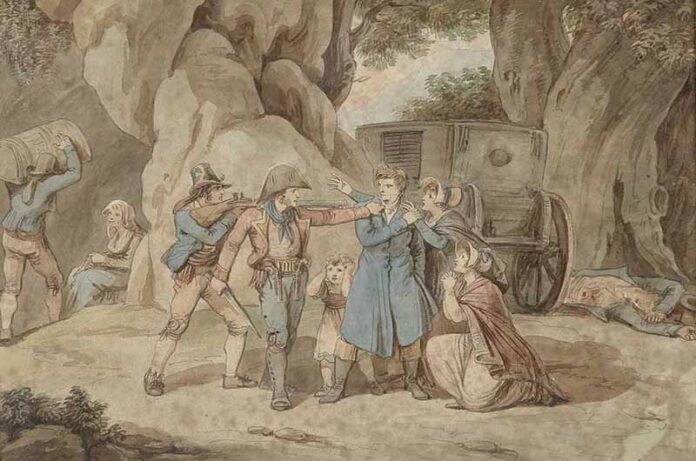
A Pinelli print—raw and direct—shows us a scene of a robbery of a traveler. It's an eloquent image of the climate prevailing in those lands: cattle theft, murders, ransoms. Among the unofficial "taxes" of the time, one stands out. the tax on brigandage: a sort of protection fee demanded from landowners in exchange for protection.
Yet the bandits weren't always on the side of the poorest. It's said that during a strike of 300 exasperated harvesters, Tiburzi showed up with a shotgun slung over his shoulder and a cigar in his mouth. Instead of defending the farmers, he "invited" them to return to work. His tone left little room for negotiation.
There was no shortage of sensational episodes, such as the escape from the Corneto penal colony (Tarquinia) where Tiburzi and Biagini, with about fifty companions, fled as if from a blockbuster. But brutality was not lacking. Such was the execution of the Marquis Guglielmi's steward, in front of forty reapers, by Domenichino himself.
Within the gangs there was a ruthless code: disobedience was paid with one's lifeNo one was safe, not even the most trusted friends.
And how can we forget? the “Beasts of Valentano”: John Grossi (Comic strip) and Dionisio Costantini (Bustrengo), never captured, so reckless as to go for a coffee right next to the Carabinieri barracks. In 1808, in Valentano, two severed heads appeared hanging on the town gate: those of the bandits Nocchia and Chiappa, a clear and macabre message to the local communities.
Shootouts with the Carabinieri were frequent, often triggered by a tip-off. The killing of the Rag-and-bone man in a cave near Canino in 1877, and that of the Domenichino in 1896 in the fields of Capalbio. But the brigands did not always die in a firefight: in Pianiano, a priest stabbed the brigand "Veleno" (Luigi Scalabrino) after being threatened by the perpetual.
Today, from that turbulent era, there remain the stories, the legends and above all the “Brigands' Path”, a suggestive itinerary of about 100 km between Lazio and Tuscany, which can be travelled by car, bike or on horseback. It starts from Vulci, you cross the remains of the city of Castro, the mysterious Lamone Forest, the silent one Lake Mezzano, the historic villages of Latera, Gradoli, Onano, Proceno, until reaching the Monaldesca within the reserve of Mount Rufeno, near Acquapendente.
The journey is a true dive into history, but also into beauty: castles, palaces, belvederes, museumsAll surrounded by unspoiled nature. And during your breaks? Trattorias, farmhouses, pizzerias... and typical products to take home: Onano lentils, Latera chestnuts, Aleatico and Gradoli extra virgin olive oil, red garlic from Proceno.
Among the historical and naturalistic jewels, the following stand out: Fiora Gorges, united by a rare Etruscan-Roman bridge, the archaeological area of Vulci with the Abbadia Castle, the Proceno fortress, The Farnese Palace of Gradoli and the enchanting view of the Lake Bolsena.
An itinerary that's also an adventure. But beware... the bandits, perhaps, never truly disappeared.



 English
  Italian